Evaluating The 2026 Draft Class
Mike M.
Round 1 — Max Iheanachor (OT, Arizona State)
Grade: A-
A very “Steelers” pick. Iheanachor fills a premium position and projects as a long-term starter at tackle.
Why it works:
- Protects the quarterback—always priority #1
- High ceiling with prototypical size and athleticism
- Immediate competition for a starting job
Knock:
Not the flashiest option on the board; some may argue a higher-impact skill player was available.
Bottom line: Safe, foundational, and smart.
Round 2 — Germie Bernard (WR, Alabama)
Grade: B+
Bernard adds speed and versatility to the receiver room and could contribute early.
Why it works:
- Strong route runner with big-game experience
- Immediate rotational impact
- Fits modern passing attack
Knock:
Not a clear WR1-type prospect; more complementary than dominant.
Bottom line: Solid value and a clean schematic fit.
Round 3 — Drew Allar (QB, Penn State)
Grade: B
This is a classic upside swing at quarterback.
Why it works:
- Elite arm talent and size
- Low-risk draft position for a QB gamble
- Developmental upside worth investing in
Knock:
Inconsistency in college; far from a sure thing.
Bottom line: Sensible gamble—but still a gamble.
Round 3 — Daylen Everette (CB, Georgia)
Grade: B
A depth pick with starter potential in a premium defensive position.
Why it works:
- Comes from a top-tier defensive program
- Good size and physicality
- Adds competition in the secondary
Knock:
Ball production and consistency have been questioned.
Bottom line: Solid, if unspectacular, value.
Round 3 — Gennings Dunker (G/OT, Iowa)
Grade: A-
Doubling down on the offensive line is a strong strategic move.
Why it works:
- Versatility across the line
- High-floor, pro-ready skill set
- Reinforces team identity
Knock:
Limited elite upside compared to earlier linemen.
Bottom line: High-floor pick that strengthens the entire offense.
Round 4 — Kaden Wetjen (WR/KR, Iowa)
Grade: A
One of the best value picks in the class.
Why it works:
- Immediate special teams contributor
- Game-breaking return ability
- Adds a unique dimension to the offense
Knock:
Offensive role may be limited early.
Bottom line: Instant impact player—great mid-round value.
Round 5 — Riley Nowakowski (FB, Indiana)
Grade: B-
A niche pick that reflects a specific offensive philosophy.
Why it works:
- Strong blocker
- Short-yardage utility
- Fits a physical run game
Knock:
Limited positional value in today’s NFL.
Bottom line: Useful—but only in the right scheme.
Round 6 — Gabriel Rubio (DE, Notre Dame)
Grade: B-
A depth addition with developmental upside.
Why it works:
- Good size and strength
- Rotational potential on the defensive line
Knock:
Limited pass-rush production.
Bottom line: Developmental piece, not an immediate contributor.
Round 7 — Robert Spears-Jennings (S, Oklahoma)
Grade: B
Late-round pick with a path via special teams.
Why it works:
- Physical, high-effort player
- Special teams upside
Knock:
Limited ceiling as a defensive starter.
Bottom line: Solid depth pick late.
Round 7 — Eli Heidenreich (RB/WR, Navy)
Grade: B+
A fun, versatile “chess piece” selection.
Why it works:
- Multi-position flexibility
- Special teams value
- Creative offensive potential
Knock:
Tweener role can limit consistency.
Bottom line: Worth the gamble this late.
Overall Draft Grade: B+
The Pittsburgh Steelers didn’t chase headlines—they built infrastructure.
What stands out:
- Offensive line rebuilt the right way
- Smart WR addition
- Measured QB investment
- Excellent mid-round value (especially Wetjen)
What holds it back:
- No clear defensive difference-maker
- Heavy reliance on development (especially at QB)
Wide recevier rankings for 2026 NFL Draft
RBIII
These are my rankings, not where I'm projecting in what order they are drafted, this is just where I see the rankings as of right now, I know this doesn't fit the "consensus draft rankings" but I dont give a shit what the people who thought Sheduer Sanders was the #2 overall pick think.
Jordyn Tyson, Arizona State (6'2", 200–203 lbs)
Tyson displays explosive separation, acrobatic body control, and strong contested-catch ability. He ranks as a top option across several boards for his short-area quickness, versatility, and high-point skills. Durability concerns appear in some evaluations, but his athletic profile and playmaking stand out when healthy.
Chris Bell, Louisville (6'2", 216–222 lbs)
Bell profiles as a big, physical possession receiver with YAC power and red-zone presence. Pre-injury production earned first-team All-ACC honors, though a late-season ACL tear in November 2025 impacts evaluation. Recovery reports indicate he is progressing ahead of schedule and expected to be cleared by training camp. Scouts note room for refinement in route salesmanship and press-beating footwork, but his frame and awareness provide upside.
Omar Cooper Jr., Indiana (6'0", 199–204 lbs)
Cooper exhibits pound-for-pound strength, toughness after contact, and reliable hands. Multiple reports highlight his playmaking in the open field and all-around production. He fits as a well-rounded contributor who wins with functional power rather than elite long speed alone.
Makai Lemon, USC (5'11", 192–195 lbs)
Lemon earns praise as an elite route technician and separator with competitive toughness. High-volume production includes Biletnikoff consideration in some circles. He plays bigger than his listed frame, showing quickness in the slot and consistent tempo manipulation. Consensus placements often group him tightly with the top tier.
Carnell Tate, Ohio State (6'2–6'3", 191–195 lbs)
Tate demonstrates smooth technique, nuance, body control, and ball skills. His 4.53 40-yard dash at the Combine drew some long-speed discussion, yet Ohio State pedigree and production (including yards-per-touchdown efficiency) keep evaluations positive. Many boards rank him among the top three for overall polish and contested situations.
K.C. Concepcion, Texas A&M (5'11–6'0", 190–196 lbs)
Concepcion shows twitchiness, burst, and route savvy as a deep threat. He appears consistently in top-8 placements for play speed and ability to create after the catch.
Germie Bernard, Alabama (~6'1", 204–209 lbs)
Bernard provides reliable production in a pro-style setting with solid size and consistency. Evaluations note his well-rounded traits without major standout weaknesses.
Ted Hurst, Georgia State (6'3–6'4", 206 lbs)
Hurst offers a big catch radius, vertical ability, and physicality at the catch point. Senior Bowl performance addressed competition-level questions. Strong deep production and testing traits (broad/vertical) support boundary upside.
Bryce Lance, North Dakota State (6'3", 204 lbs)
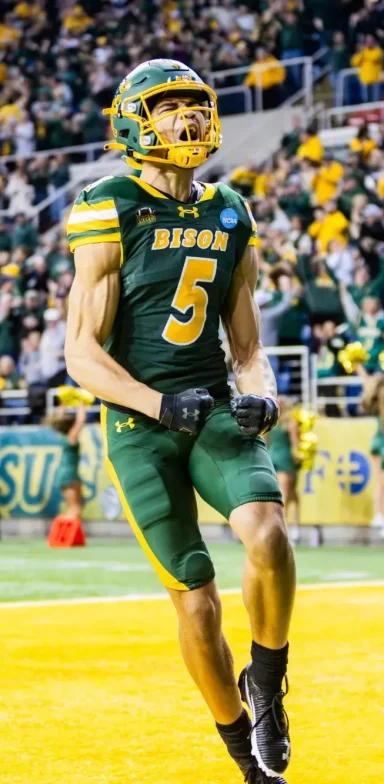
Lance brings plus athleticism from the FCS level, including reported 4.34 speed in some evaluations. Length and big-play ability project him as a developmental outside option with testing pop.
Ja'Kobi Lane, USC (6'4", ~195 lbs)
Lane possesses length for contested catches and outside development. He shows up in mid-tier boards for frame and potential.
Antonio Williams, Clemson (~5'11", ~191 lbs)
Williams works primarily from the slot with quickness and YAC ability. Size sits near the threshold without triggering the strictest penalties; consistency earns mentions in Day 2 conversations.
Chris Brazzell II, Tennessee (6'4–6'5", ~200 lbs)
Brazzell functions as a lengthy contested-catch specialist with strong red-zone traits. Several expert lists place him in the early top 5 for catch radius and ball skills.
Skyler Bell, UConn (~5'11–6'0", ~186–192 lbs)
Bell demonstrates productivity with burst and positional flexibility. Vertical and broad testing stand out; he plays with competitiveness that exceeds raw measurables in some views.
Deion Burks, Oklahoma (~5'9–5'10", 180–184 lbs)
Burks flashes speed and big-play ability from the slot or gadget roles. Size concerns limit projection to more specialized contributions in zone or motion schemes.
Elijah Sarratt, Indiana (6'2", ~209 lbs)
Sarratt brings a big-play frame and production flashes. He fits as a complementary boundary threat with size.
Denzel Boston, Washington (6'3.5–6'4", 209–212 lbs)
Boston recorded solid 2025 production (around 62 receptions, 881 yards, 11 TDs in one reporting line) with strong ball skills and contested-catch rate. Size suits the X-receiver role, yet evaluations note limited separation on verticals, press-man disruptions, and route polish. Skipped or limited athletic testing in spots fuels questions about explosiveness and NFL translation of his physical college style.
1- Omar cooper
2 Chris bell
3 Carnell Tate
4 Jordan Tyson
5 Antonio Williams
6 kc conception
7 Germie Bernard
8 Malaki lemon
9. Chris brazell
10. Denzel boston.
11. Elijah seratt
12. Ted hurst
13. Jakobi lane
14. Zachariah branch
15. Bryce lance
16. Malachi fields
Mock Draft Monday!!
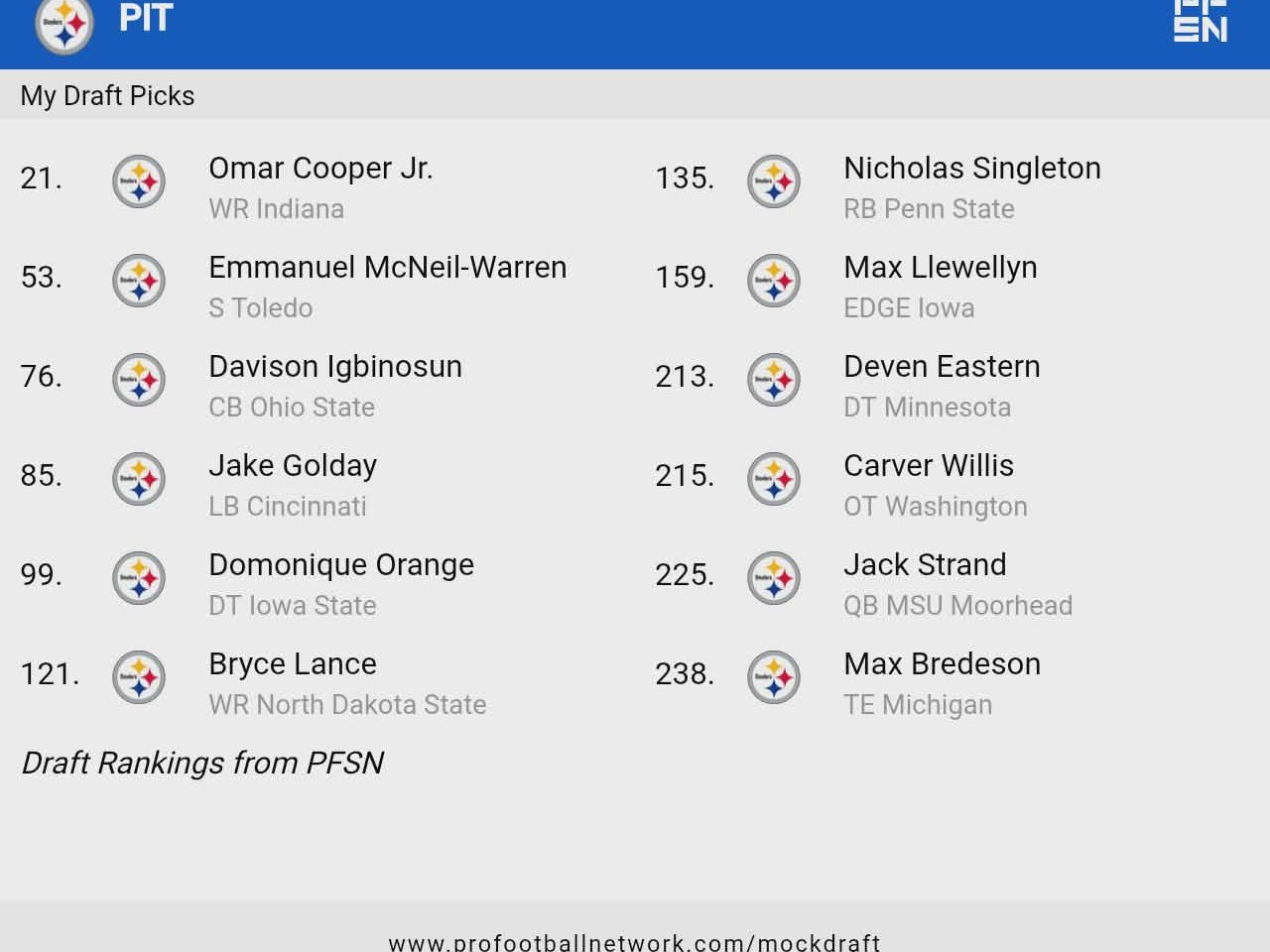
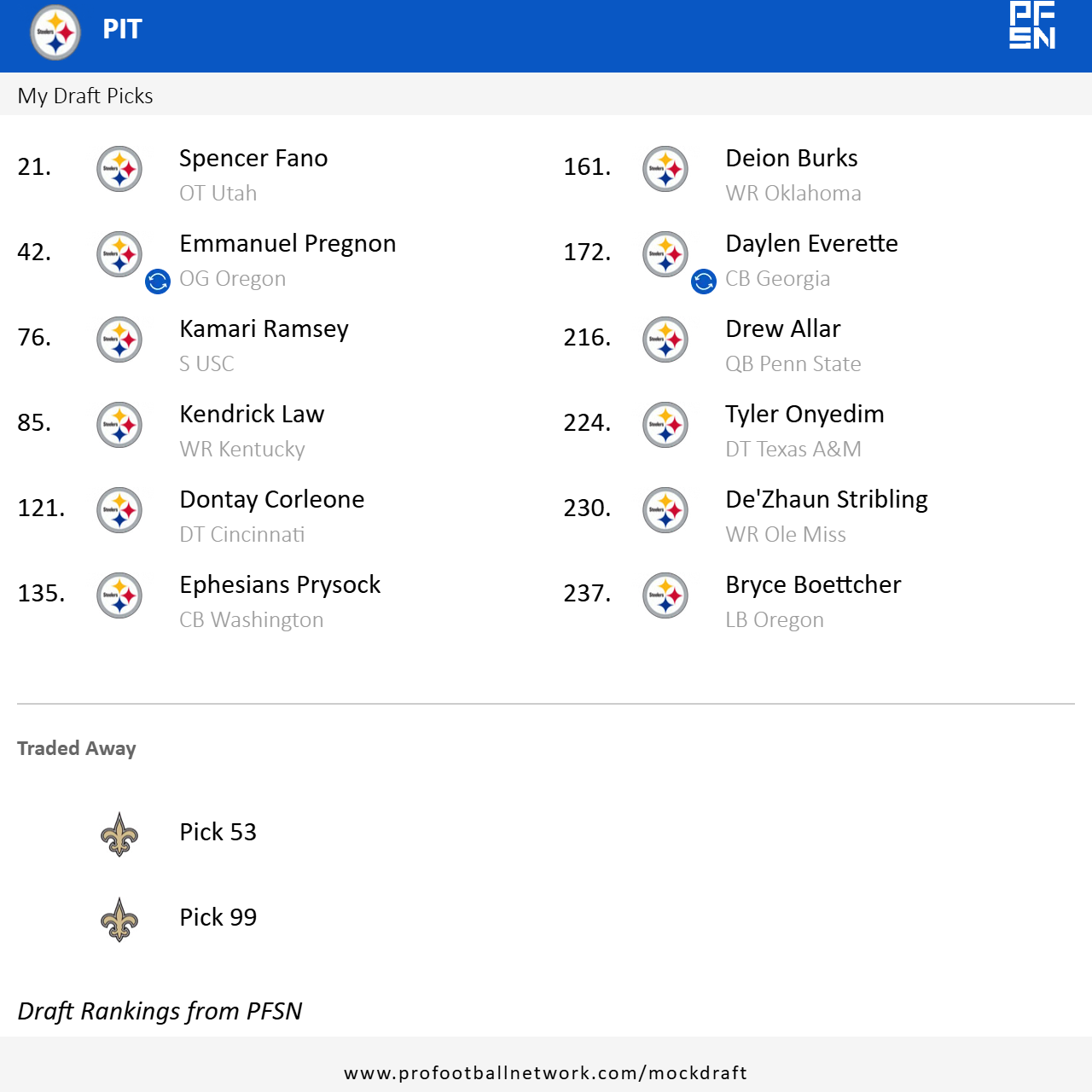
In today's Mock Draft Monday, we have our very first trade up in the second round! In this mock trade, the Pittsburgh Steelers send picks 53 & 99 to the New Orleans Saints for pick 42. This aggressive move demonstrates General Manager Omar Khan's commitment to addressing critical roster needs through the NFL mock draft 2025. The Steelers used their first pick, number 21, on tackle Spencer Fano out of Utah and used their second-round pick on Oregon guard Emmanuel Pregnon. These two strategic selections allow General Manager Omar Khan to complete the Steelers offensive line reconstruction project. By drafting Fano, 2024 first-round pick Troy Fautanu will move to left tackle since he is a better pass protector than Fano. Pregnon will start at left guard, Zack Frazier at Center, Mason McCormick at Right guard, and Spencer Fano at Right Tackle.
This offensive line configuration represents a significant upgrade for the Pittsburgh Steelers. The combination of youth and talent across all five positions should provide the protection necessary for the team's offensive success. Fano brings exceptional run-blocking ability to the right tackle position, while Pregnon's versatility and power make him an ideal fit at left guard. This reconstructed offensive line should dominate at the line of scrimmage for years to come.
Using three picks, the Steelers add much-needed depth and talent to their receiving core. Using picks 85 to select Kendrick Law, 161 to draft Deion Burks, and 230 to nab De'Zhaun Stribling. These three will compete against veterans Roman Wilson and Ben Skoronik for major playing time in Mike McCarthy's new offensive scheme.
The wide receiver position has been a glaring weakness for the Pittsburgh Steelers in recent seasons. Law brings elite speed and route-running ability that should translate immediately to the NFL level. Burks offers size and contested-catch ability that the offense desperately needs. Stribling represents a developmental prospect with tremendous upside. These additions through the NFL mock draft simulator demonstrate the front office's commitment to surrounding their quarterback with legitimate weapons.
The Steelers also made numerous picks to address depth in their secondary by drafting Safety Kamari Ramsey and Cornerbacks Ehesians Prysock and Dayl Everette.
The secondary needed an infusion of young talent to complement the veteran presence already on the roster. Ramsey brings exceptional range and ball skills to the safety position. His ability to play both deep and in the box makes him a versatile weapon for the defensive coordinator. Prysock offers length and physicality at cornerback, while Everette provides speed and coverage ability. These three selections strengthen a secondary that must improve to compete in the AFC North.
The steal of the draft may be massive defensive tackle Dontay Corleone. This massive human may just be the answer the Steelers have been looking for to anchor the middle of their defensive line.
Corleone's combination of size, strength, and athleticism makes him a perfect fit for the Pittsburgh Steelers defensive scheme. His ability to command double teams will free up linebackers to make plays. The defensive tackle position has been a weakness for too long. Corleone should step in immediately and make an impact. His presence in the middle should transform the entire defensive front.
Finally, the Steelers address the quarterback position by taking a late-round gamble on former Penn St. quarterback, Drew Allar. Using a late-round pick on a project QB that can sit and develop for a few years might be a move that pays dividends for years to come.
Allar possesses all the physical tools necessary to succeed at the NFL level. His arm strength and size make him an intriguing developmental prospect. The Pittsburgh Steelers have always valued having multiple quarterbacks on the roster who can compete and push each other. This selection through the NFL mock draft 2025 provides insurance and potential future value. Allar can learn the system without pressure and develop into a legitimate starter down the road. This type of strategic thinking separates good front offices from great ones.
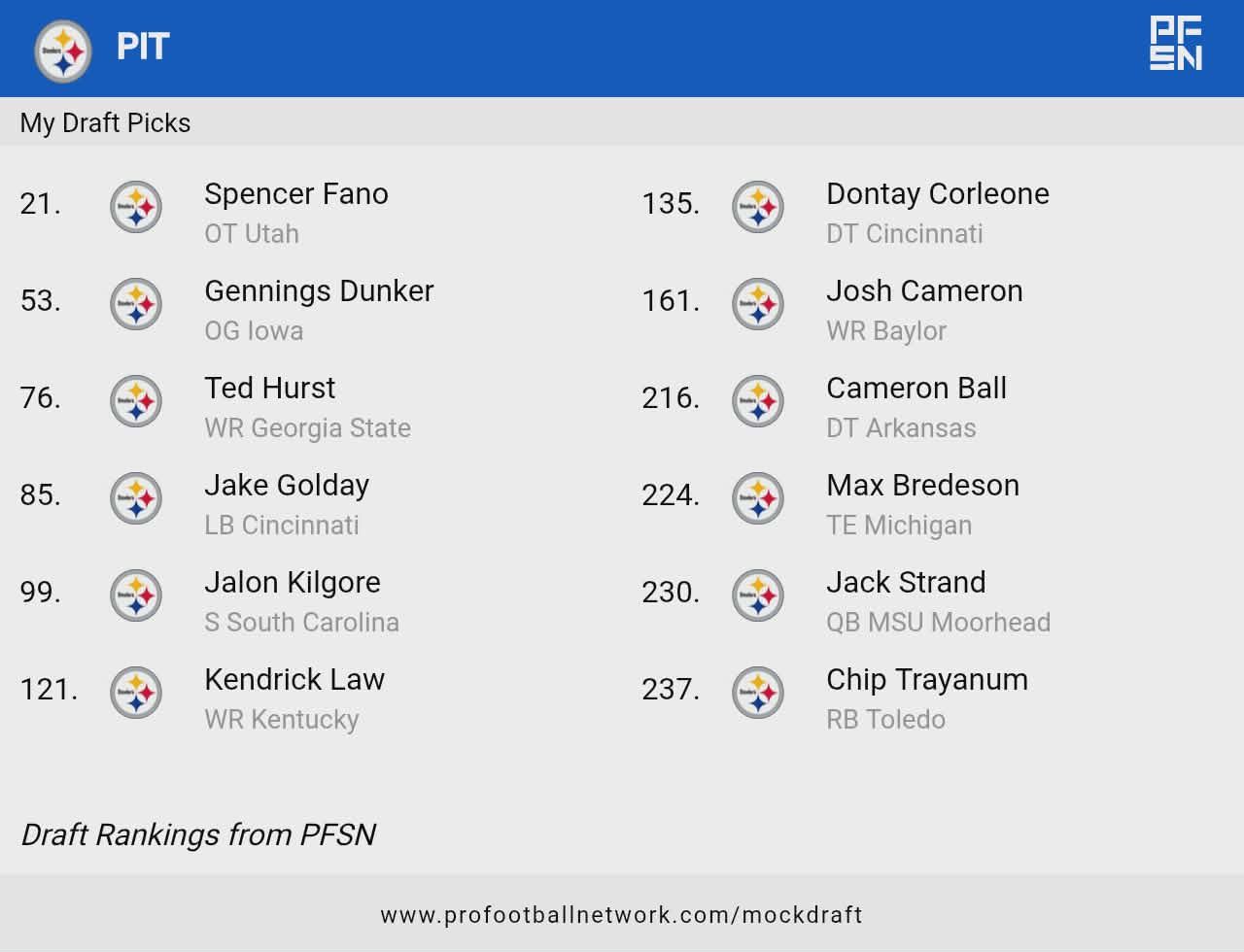
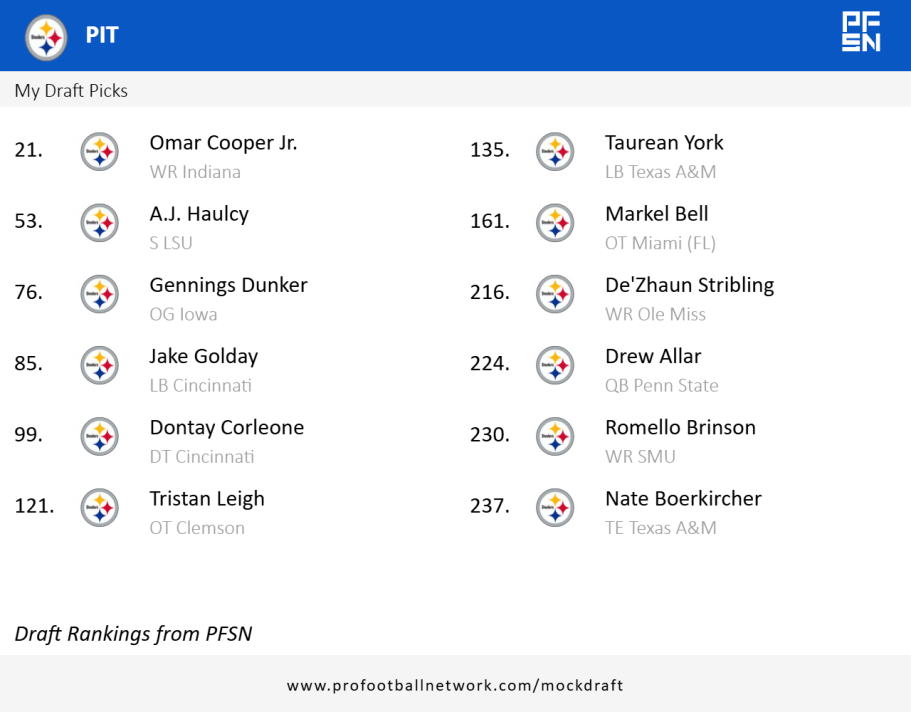
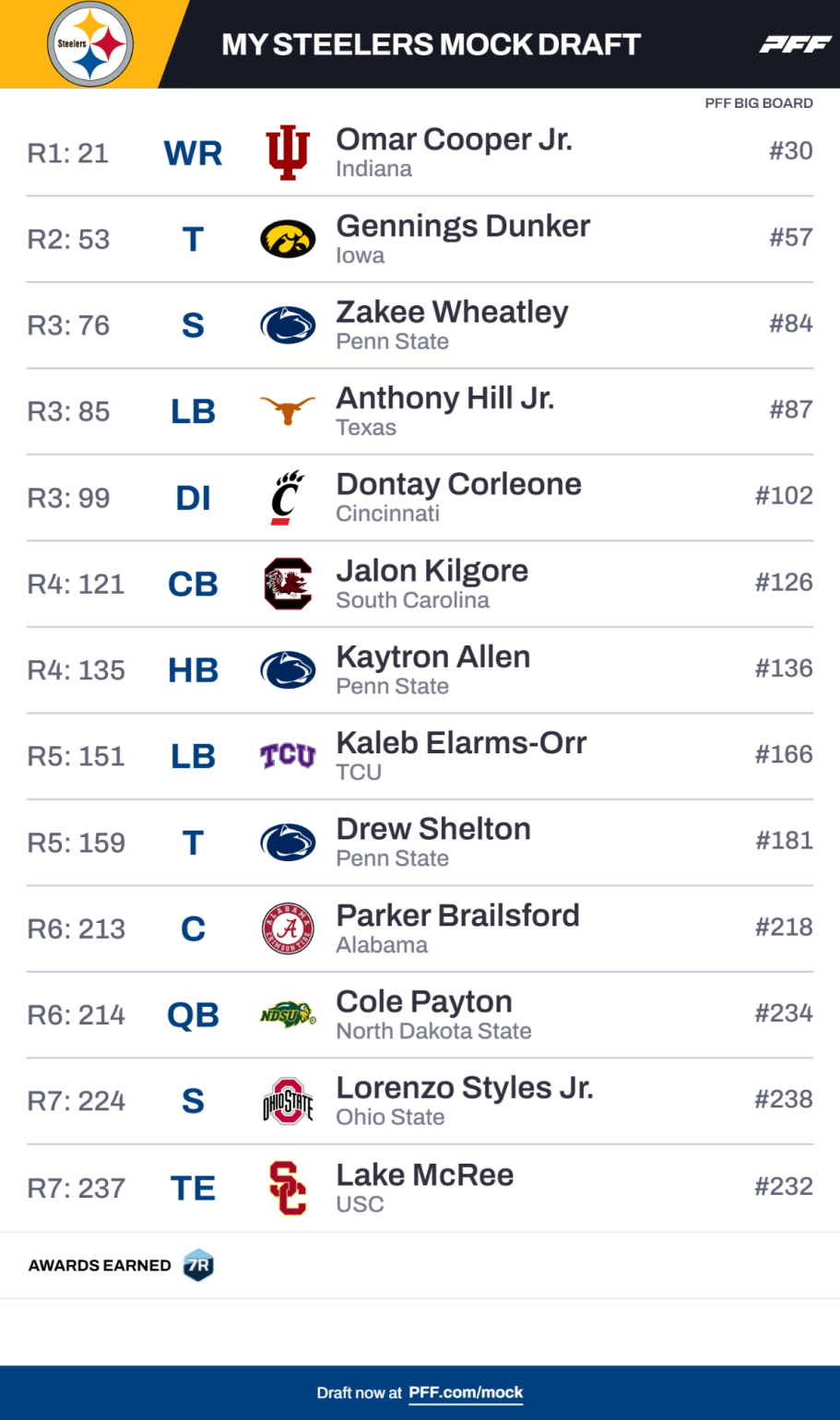
Steelers’ Late-Round Gem? Omar Cooper Jr.’s Combine Explosion Catapults Him Into First-Round Conversation
By RbII
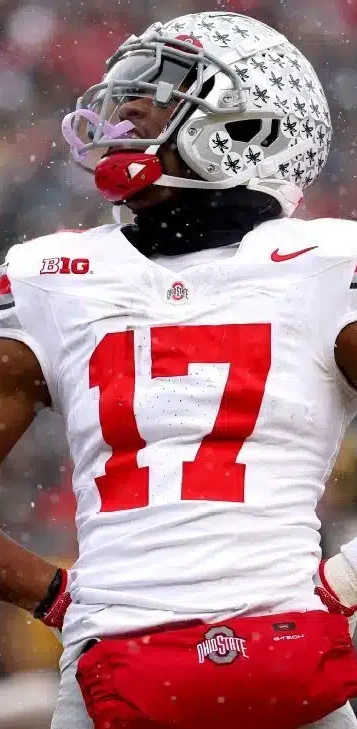
Just days after the 2026 NFL Scouting Combine wrapped, one name is suddenly impossible to ignore in first-round chatter: Indiana wide receiver Omar Cooper Jr.
What was once viewed as a solid Day 2 prospect has rocketed up boards after a dazzling on-field showing in Indianapolis. With the Pittsburgh Steelers sitting at No. 21 overall and desperate for a playmaking wideout to complement George Pickens, Cooper Jr. has emerged as a legitimate target — and the tape plus the testing numbers suggest he could be a perfect culture and schematic fit in Pittsburgh under new head coach Mike McCarthy.
The Combine That Changed Everything
Cooper Jr. clocked an official 4.42-second 40-yard dash — elite for a 6-foot, 200-pound receiver with his physical build — and exploded for a 37-inch vertical leap. Those numbers, paired with his already impressive production (69 catches, 937 yards, 13 touchdowns in 2025 en route to a national title), have teams rethinking his ceiling.
Pre-Combine, most projections pegged him as a late-second-rounder. Post-Combine, analysts and mock drafters are sliding him into the back half of Round 1. The athletic testing confirmed what the film has shown for two seasons: this is a sudden, explosive playmaker who wins with more than just straight-line speed.
Why Cooper Jr. Is Rising — and Why the Steelers Are Taking Notice
Several factors have teams convinced Cooper Jr. is worth a first-round investment:
Elite YAC Threat and Playmaking After Contact: He ranks among the top receivers in forced missed tackles and routinely turns short throws into chunk gains. His compact, muscular frame allows him to run through arm tackles and create lateral separation even after the catch.
Polished Route Runner With Versatility:
Whether aligned in the slot (his primary home in 2025) or split wide, Cooper Jr. shows precise footwork, tempo manipulation, and the ability to beat press coverage with quick releases. He digs into stems, snaps his head around on time, and understands leverage against zone and man alike.
Contested-Catch Reliability and Ball Skills: Strong hands, excellent body control, and a willingness to fight through contact make him a nightmare on 50/50 balls and in the red zone. He tracks the deep ball naturally and leaps at its apex.
Explosive Athleticism That Translates: The 4.42 speed and 37-inch vertical weren’t flukes — they match the suddenness he shows on tape, where he creates separation in the first two steps and stacks defenders vertically.
Those traits weren’t just combine fireworks; they powered a championship run at Indiana and now have NFL coordinators salivating.
A Seamless Fit in Steelers Culture
Pittsburgh has built its identity on toughness, work ethic, and players who embrace the blue-collar mentality that defines the organization under the Rooney family. Cooper Jr. checks every box.
He plays with a physical edge that belies his size — welcoming contact, finishing blocks downfield, and competing every snap the way Steelers fans have come to expect from their stars. Teammates and coaches at Indiana raved about his leadership during the Hoosiers’ title run. In a locker room that values veterans like Cameron Heyward and T.J. Watt, Cooper Jr.’s competitive fire and no-nonsense approach would fit right in.
General manager Omar Khan has repeatedly emphasized character and toughness in recent drafts. Cooper Jr. isn’t a diva receiver chasing highlights — he’s a football player who elevates everyone around him, aligning perfectly with the Steelers' enduring culture.
How He Slots Into a Mike McCarthy-Style Offensive System:
Cooper Jr.’s skill set would thrive in the motion-heavy, YAC-centric offense Mike McCarthy has long championed (and that produced consistent success in Green Bay and Dallas). McCarthy’s scheme emphasizes rhythm throws, pre-snap motion to create mismatches, and receivers who can win underneath and then punish defenses in space.
Cooper Jr. is tailor-made for it:
His ability to align anywhere — slot, outside, or in jet motion — gives play-callers the same flexibility McCarthy has used to keep defenses guessing.
The quick-twitch acceleration and elite short-area burst turn quick screens and intermediate crosses into explosive plays, exactly the kind of chain-movers McCarthy’s quarterbacks have feasted on.
His route precision and timing fit perfectly with play-action boots and layered concepts that McCarthy deploys to stretch the field horizontally and vertically.
In short, Cooper Jr. wouldn’t just contribute in Pittsburgh he would immediately become a chess piece who forces defensive coordinators to account for him on every snap in McCarthy's system.
The Bottom Line
The 2026 NFL Draft is still weeks away, and plenty can change between now and late April. But Omar Cooper Jr. left Indianapolis with something every top prospect dreams of: momentum.
For the Steelers at No. 21, the combination of rising stock, elite athletic testing, and schematic versatility makes him more than just a name to watch — he could be the difference-maker who finally gives Pittsburgh the explosive, reliable wideout it has been searching for under the new regime.
If Khan and the front office pull the trigger, Steelers Nation might look back at the 2026 Combine as the moment Omar Cooper Jr. became a Pittsburgh Steeler.
Steelers Fans, Hold Off on the Panic: The WR Depth in 2026 Could Deliver Gems Like Ted Hurst
By RBII
As the 2026 NFL Draft nears, Steelers Nation is understandably eager for reinforcements at wide receiver. With questions about the group's depth and the need for reliable targets, the temptation is strong to push for an early-round pick at the position. But before frustration sets in if the Black and Gold don't select a wideout in Round 1—or even Round 2—remember this: the 2026 wide receiver class is exceptionally deep, offering quality talent well into the later rounds. Under new head coach Mike McCarthy, the Steelers can be strategic and patient, potentially landing a high-upside player who fits the scheme without spending premium draft capital. One such prospect is Georgia State standout Ted Hurst, whose size, athleticism, and production profile make him a compelling mid-round option.
McCarthy's track record shows a clear preference for physical, versatile receivers who can win contested catches and contribute at multiple levels, and Hurst aligns well with that vision. Let's examine why he could thrive in Pittsburgh, how his measurables compare to McCarthy's past picks, his key strengths in the system, a pro comparison, and parallels to former Steelers WR George Pickens in playing style.
Why Hurst Fits Mike McCarthy's Vision
Mike McCarthy has long favored receivers with size and physicality who can operate effectively on the boundary while offering some flexibility. Over his coaching tenure, his drafted wideouts have trended toward taller, sturdy builds capable of winning in contested situations and stretching the field—traits that suit a balanced, play-action-oriented offense. Hurst embodies this archetype: a tall, explosive outside threat who excels at high-pointing the ball and creating separation with his stride and speed. In McCarthy's scheme, which emphasizes precise route-running, red-zone efficiency, and vertical shots, Hurst's ability to attack deep and win at the catch point would provide a dependable option for Aaron Rodgers, giving the veteran QB a big-bodied target to exploit mismatches.
Size and Athletic Profile: A Match for McCarthy's Prototypes
McCarthy's history reveals a preference for receivers around 6-1 to 6-3 with solid builds, good length, and enough athleticism to separate—avoiding extremes of very short or overly lanky jump-ball specialists. Many of his picks (especially post-2015) emphasize height over 6-0, long arms, and functional speed for perimeter play.
Hurst measures 6-4 and 206 pounds, with 32 5/8-inch arms, putting him on the taller end but still in the athletic sweet spot. His estimated 4.42-second 40-yard dash highlights elite burst and long speed for his frame, complemented by strong testing in vertical and broad jumps. This profile echoes McCarthy favorites like bigger-bodied outside threats who combine length with fluidity, allowing them to win releases against press coverage and dominate downfield—much like the physical prototypes McCarthy has targeted for boundary roles.
Strengths in the Steelers' System
Hurst's skill set translates seamlessly to McCarthy's pro-style attack: Deep-Field Threat: He consistently grades highly on targets 20+ yards downfield, using his speed and catch radius to stretch defenses. This fits perfectly with play-action boots and shots off motion, opening underneath options for tight ends and slots.
Contested-Catch Ability: His length and timing at the high point make him a red-zone nightmare, winning fades, back-shoulder throws, and 50/50 balls—addressing a key area where the Steelers could use more reliability.
YAC and Versatility: Averaging strong yards per catch, Hurst shows vision and stride to turn short completions into chunk gains. While primarily an outside "X" or "Z" receiver, he can motion for mismatches, adding wrinkles to McCarthy's alignments.
Refinements needed—like polishing his route tree and minimizing occasional drops—are coachable, especially in a system that has elevated similar raw talents into consistent producers.
Pro Comparison: A Modern Twist on a Familiar Type
Hurst draws comps to a young Courtland Sutton: tall, rangy, and explosive vertically, with the tools to develop into a reliable WR2 who commands attention from defenses. Like Sutton, he blends size with enough fluidity to win beyond just jump balls, potentially growing into a polished boundary starter.
How He Compares to Ex-Steelers WR George Pickens (Playing Style)
For Steelers fans missing the big-play element George Pickens brought during his time in Pittsburgh, Hurst offers intriguing stylistic parallels as an outside vertical threat. Both are lengthy boundary receivers with elite contested-catch skills, deep speed (Pickens around 4.47, Hurst in the low-4.4s), and the ability to high-point throws against smaller corners. Hurst's explosive testing (including superior broad jump metrics) suggests comparable or even enhanced burst off the line.
The key difference: While Pickens entered the league as a more polished route-runner, Hurst's college production (over 1,900 yards and 15 TDs in his final two seasons at Georgia State) shows strong consistency against coverage, often outpacing expectations for his level of competition. He could help replicate that downfield dynamism Pickens provided—commanding safeties deep and winning in jump-ball situations—while potentially offering a cleaner off-field profile and solid YAC upside.
Draft Projection: A Day 2 or 3 Steal?
Hurst projects as a Day 2 or early Day 3 pick in most mocks, often in the third-to-fifth round range (roughly picks 70-150 overall). His Group of Five background and the deep class could allow him to slide, but rising buzz from the Senior Bowl and combine has some scouts viewing him as a top-100 talent with starter upside as a "Z" or "X" receiver. For the Steelers, landing him in the mid-rounds would represent excellent value—a high-ceiling addition ready to contribute without forcing an early reach.
Steelers fans, this draft rewards smart, scheme-aligned selections over panic picks. If McCarthy zeros in on a player like Hurst, it could quietly fortify the offense for years to come. In a class this loaded, patience might deliver the next big-play weapon to wave the Terrible Towel for.
Jack Strand: The 2026 NFL Draft's Best-Kept Secret with Elite Arm Talent
By RBII
In a 2026 NFL Draft class that's been dissected from every angle, with quarterbacks from Power Five conferences like Indiana's Fernando Mendoza and Texas' Arch Manning grabbing the spotlight, there's one name that remains shrouded in obscurity: Jack Strand. Hailing from the Division II ranks at Minnesota State University Moorhead (MSU Moorhead), Strand isn't just another small-school hopeful—he possesses what many scouts quietly agree is the premier arm talent in this entire draft. If you've never heard of him, you're not alone. But as the draft approaches in late April, this under-the-radar gunslinger could be the steal that reshapes a franchise's future, particularly one like the Pittsburgh Steelers under new head coach Mike McCarthy.
A Cannon Disguised as a Division II Arm
Strand's arm talent isn't hyperbole; it's a verifiable weapon that sets him apart in a class where arm strength is often good but rarely transcendent. At 6'5" and 240 pounds, he boasts prototypical NFL size, allowing him to generate effortless velocity on throws that would challenge most prospects. His ability to zip the ball into tight windows, even from awkward platforms, evokes comparisons to elite off-script playmakers like Patrick Mahomes or a young Aaron Rodgers—high praise, but backed by tape.
What makes Strand's arm truly special is its functionality under duress. He excels at throwing off-platform, adjusting his base mid-play to deliver strikes while evading pressure. In his senior season at MSU Moorhead, Strand demonstrated this repeatedly, completing deep outs and crossers with laser precision despite collapsing pockets. His mechanics hold up on the move, thanks to a quick release and natural torque from his hips and core.
Add in some underrated mobility—Strand rushed for 288 yards and five touchdowns in 2025, showing he can extend plays with his legs—and you have a quarterback who isn't just a statue in the pocket.
Over his collegiate career, Strand shattered NSIC records with over 13,000 passing yards and 126 touchdowns, culminating in a 2025 campaign where he led Division II with 42 scoring strikes. Accolades poured in: NSIC Offensive Player of the Year, Harlon Hill Trophy finalist (finishing fourth), and multiple All-America honors. Yet, because of his DII pedigree, he's projected as a late-round pick (Rounds 4-7) or even a priority undrafted free agent. The knock? Level of competition. But in pre-draft showcases like the Shrine Bowl or NFL Combine, where he'll face top talent, Strand's traits could catapult him up boards.
A Perfect Fit for the Pittsburgh Steelers and Mike McCarthy's Vision
The Pittsburgh Steelers, entering the 2026 season with a revamped coaching staff led by head coach Mike McCarthy, represent an ideal landing spot for a developmental talent like Strand. McCarthy, fresh off his tenure with the Dallas Cowboys and bringing a Super Bowl pedigree from his Green Bay days, has a proven track record of molding quarterbacks with elite arm talent into stars. Think Brett Favre's gunslinging flair or Aaron Rodgers' off-platform wizardry—McCarthy's offenses thrive on quarterbacks who can improvise and stretch the field vertically.
In Pittsburgh, the Steelers' quarterback room is in flux. With Russell Wilson potentially entering the twilight of his career and Justin Fields still proving his consistency, the team needs a high-upside project to groom behind the starters. Strand's arm strength aligns seamlessly with McCarthy's West Coast-inspired scheme, which emphasizes timing routes but rewards playmakers who can ad-lib when protections break down. His size and mobility would allow him to handle the physicality of the AFC North, where cold-weather games and rugged defenses demand resilience.
Under McCarthy, Strand could initially contribute as a practice squad arm or third-stringer, learning the nuances of NFL footwork and decision-making. McCarthy's coaching tree, including assistants with ties to his Packers era, would provide the structure to refine Strand's occasional over-aggressiveness—turning raw potential into polished production. Imagine Strand uncorking frozen-rope throws to George Pickens on deep posts or escaping sacks to find Pat Freiermuth on the move. It's a match that could pay dividends, especially if Strand's intangibles (leadership as a multi-year captain and a 3.87 GPA in Engineering Physics) help him absorb a pro playbook quickly.
Despite the long odds of a late-round or UDFA path, Strand has a legitimate shot to stick in the league. Small-school success stories abound—think Tony Romo (Eastern Illinois) or even McCarthy's own experience with undrafted talents. If Strand impresses at pro days and workouts, he could follow in their footsteps, proving that elite arm talent transcends divisions.
As the 2026 draft unfolds, keep an eye on Jack Strand. He may be the prospect you've never heard of, but his arm could echo through the NFL for years to come—especially if he lands in the Steel City under Mike McCarthy's tutelage.
Tempering the Hype: Why Washington WR Denzel Boston May Not Warrant First-Round Buzz in the 2026 NFL Draft
RBII
In the lead-up to the 2026 NFL Draft, few prospects have generated as much pre-combine chatter as Washington Huskies wide receiver Denzel Boston. The 6-foot-4, 209-pound pass-catcher has been slotted into the mid-first round in several high-profile mock drafts, drawing comparisons to physical boundary receivers like Alshon Jeffery or even Puka Nacua for his contested-catch prowess and red-zone dominance. With back-to-back 800-plus yard seasons and 20 touchdowns over the past two years, it's easy to see why scouts are intrigued. Boston led the Huskies in receptions (62), yards (881), and scores (11) in 2025, showcasing a knack for winning at the catch point with a 76.9% contested-catch rate that ranked among the nation's best.
Yet, amid the glowing projections, a closer examination of Boston's tape and measurables reveals cracks in the foundation. While his size and ball skills make him a tantalizing Day 2 option, the hype as a surefire first-rounder feels inflated. From athletic limitations to inconsistencies against elite competition, here's why Boston might be more of a developmental project than an immediate impact player worthy of top-32 capital.
Not the Burner His Frame Suggests
At just 209 pounds—lighter than many of his big-bodied peers—Boston should theoretically possess the speed to stretch defenses vertically. However, his athletic profile doesn't scream "elite separator." Scouting reports peg his 40-yard dash in the 4.52-second range, a solid but unremarkable time that places him in the 44th percentile among wide receivers. For context, that's slower than expected for a sub-210-pound frame, where prospects often compensate for mass with explosive burst. Boston's game speed plays up on film when given a clean release, but he lacks the raw acceleration to consistently blow past NFL-caliber corners.
This was evident at the NFL Combine, where Boston opted not to run the 40-yard dash—a decision that raised eyebrows and amplified concerns about his long speed.
His 35-inch vertical (45th percentile) and 4.28-second shuttle (38th percentile) further underscore a profile that's more smooth than sudden. Without elite explosion, Boston's ability to create yards after the catch or win on deep routes could be capped in a league where defensive backs are faster and more physical than ever.
Struggles Against Top-Tier Corners
Boston's production dipped noticeably against Washington's toughest opponents, a red flag for a prospect being touted as a plug-and-play starter. In matchups against Ohio State and Oregon—teams loaded with NFL-quality defensive backs—his output was muted, with scouts noting he couldn't consistently separate underneath or handle physical press coverage. Physical corners rerouted him too easily downfield, and his contested-catch wins came more from scheme than individual dominance.
This inconsistency echoes broader scouting concerns: Boston thrives against lesser competition but gets "beat up" when defenders dictate terms. In the pros, where every snap features press-man specialists, his reliance on size over savvy could lead to early frustrations. As one report noted, "Numbers dipped against the better corners on the schedule," highlighting a pattern that questions his readiness for a featured role.
Stiff Hips, Limited Routes, and Separation Woes
Boston's athleticism is described as "smooth" for his size, but terms like "not especially twitchy" and "lacking suddenness out of breaks" appear frequently in evaluations. This points to stiff hips that hinder his ability to sink and explode on sharp cuts, limiting his route tree to primarily verticals, posts, and in-breakers. While he sells doubles moves well and uses his frame to box out, his routes lack the finesse and detail needed for a full NFL arsenal.
Separation is the biggest knock: Boston "isn't going to run past NFL corners with pure speed," and his burst inconsistencies show up on underneath patterns. He needs to develop more craftiness off the line to avoid jams, as physical press often knocks him off path. In a draft class with more explosive options, Boston's profile screams reliable possession receiver rather than dynamic WR1.
The Hype Machine: Agents and Mock Draft Manipulation
Part of Boston's first-round buzz may stem from the shadowy side of draft season, where agents reportedly influence mock drafts to inflate their clients' stock. While not outright confirmed as "paying" for slots, industry insiders acknowledge that early mocks can involve favors—agents feeding intel to analysts in exchange for prominent placements that create momentum. As Rams GM Les Snead has hinted, some projections feel like "doing a favor for an agent," especially pre-combine when real evaluations are scarce.
This practice builds artificial hype, potentially pushing players like Boston higher than their tape warrants. Teams track mock accuracy and betting odds as part of their process, but the echo chamber can mislead fans and even scouts. In Boston's case, his mid-first projections might reflect this buzz more than a consensus on his upside.
Final Verdict: Solid Prospect, But Not First-Round Lock
Don't get it wrong—Boston has the tools to carve out a solid NFL career. His hands, body control, and red-zone instincts make him a mismatch nightmare, and his willingness to block adds value in run-heavy schemes. A team like the Buffalo Bills, seeking a "dream target" for Josh Allen, could see him as a fit in Round 2.
But as a first-rounder? The speed concerns, separation issues, and uneven tape against top competition suggest he's overhyped. In a draft where true separators and twitchy athletes rise quickly, Boston risks sliding if his pro day doesn't wow. Teams investing early should temper expectations: He's a high-floor contributor, not the explosive star the mocks portray.
Draft Guru R.B's Top 5
Top 5 Targets For The Steelers
1. Kenyon Sadiq (TE/WR Hybrid, Oregon)
The Ultimate Mismatch Weapon at TE1 Kenyon Sadiq has cemented his status as a top-20 lock after a historic Combine performance: a record-breaking 4.39-second 40-yard dash (fastest ever for a TE), 43.5-inch vertical (tied for elite), and 11'1" broad jump at 6'3", 241-245 pounds. Ranked as high as No. 16 overall by Daniel Jeremiah and consensus TE1, his 2025 stats (51 catches, 560 yards, 8 TDs leading FBS TEs) showcase red-zone dominance, contested-catch ability, and YAC burst, with comparisons to explosive hybrids like Tyler Warren or even big-bodied WR traits akin to DK Metcalf. Why a first-round steal for the Steelers at No. 21? McCarthy's offenses thrive on versatile tight ends who create mismatches in the passing game—Sadiq's freakish speed and explosiveness allow him to flex wide, slot, or inline in 12-personnel, stretching defenses vertically and adding a dynamic YAC/red-zone element missing from Pittsburgh's attack. His solid blocking fits run-heavy packages, while his athletic profile (sub-4.4 speed at 240+ pounds) makes him a nightmare for linebackers/safeties. If available in the mid-20s (plausible given positional value debates), he'd provide immediate starter upside as a "big WR" hybrid, accelerating the offensive transition and giving McCarthy a weapon to scheme open.
2. Omar Cooper Jr. (WR, Indiana)
Rising YAC Monster and WR2 Contender Omar Cooper Jr. has skyrocketed up boards post-Combine, landing in the top 20 (No. 19 by Jeremiah, No. 17 by some big boards) as one of the draft's premier slot/versatile receivers. At 6'0", 199-204 pounds, his elite hands (career 4.2% drop rate), tackle-breaking YAC ability, and acceleration make him a high-floor, high-ceiling playmaker with production (115 career catches, 1,798 yards, 22 TDs) and testing that supports first-round buzz. Why a first-round fit for Pittsburgh? The Steelers desperately need reliable, explosive options beyond Metcalf to fuel McCarthy's quick-game and play-action attack—Cooper's YAC wizardry (among the class leaders) turns short passes into chunk plays, sustains drives, and exploits zones/motion concepts. His versatility to align slot or outside adds schematic flexibility, addressing depth concerns and providing a "plug-and-play" WR2/3 with star potential. If his stock holds in the late teens to mid-20s, he's a realistic target at No. 21, embodying the high-upside skill-position investment McCarthy has historically prioritized to elevate offenses.
3. Dillon Thieneman (S, Oregon)
Elite-Athletic Ballhawk for the Back End Dillon Thieneman exploded at the Combine with a 4.35-second 40 (elite for safeties), 41-inch vertical, and 10'5" broad jump at 6'0", 201 pounds—earning praise as one of the draft's top coverage safeties with rangy instincts, over 300 career tackles, and eight INTs. Now firmly in first-round discussions (top-25 range on multiple boards), his tape shows free safety range, big-nickel versatility, and turnover creation. Why a first-round priority for the Steelers? Safety is a glaring need with potential roster flux, and Graham's aggressive scheme craves versatile, explosive DBs who can cover ground, play man/zone, and force mistakes. Thieneman's athleticism (top-ranked at the position) and production make him an immediate impact starter or high-end rotational piece, adding youth and playmaking to a secondary needing more dynamism opposite Joey Porter Jr. If he slips to the mid-20s (possible given safety valuation), he'd be a premium first-round value, fitting Pittsburgh's defensive identity while providing long-term stability.
4. Brandon Cisse (CB, South Carolina)
Physical Press Corner with Rising Stock Brandon Cisse, at 5'11"-6'0", 189 pounds, brings explosive burst, length, and press-man physicality, with strong run support and PBUs on tape. His Combine athleticism and traits have pushed him into late-first/early-second conversations (top-30 to mid-30s range), with upside as a sticky outside corner. Why a first-round option for Pittsburgh? Corner depth opposite Porter Jr. is critical, and Graham favors aggressive, physical DBs who disrupt at the line and support the run. Cisse's press skills and downhill triggers align perfectly, offering a high-ceiling starter to bolster the secondary's edge. If available around No. 21 (or via a small move), he'd provide immediate competition and youth, addressing a premium need with traits that translate to Graham's man-heavy looks.
5. Jacob Rodriguez (LB, Texas Tech)
Butkus Winner with First-Round Playmaking Upside Jacob Rodriguez, the 2025 Butkus Award winner, boasts elite production (seven forced fumbles, four INTs in 2025, 300+ career tackles) at 6'1", 235 pounds, with versatility in run defense, coverage, and blitzing. While often mid-round projected, his instincts, turnover-forcing ability, and Senior Bowl buzz have some viewing him as a fringe first-round riser in a deep LB class. Why a first-round consideration for the Steelers? Linebacker youth and disruption are long-term concerns—Rodriguez's nose for the ball fits Graham's emphasis on forcing turnovers, making him a potential ILB starter in sub-packages or base. His production and "starter traits" offer high floor/upside; if he climbs into the 20s (plausible with playmaking pedigree), he'd be a culture-fit steal at No. 21, adding immediate impact to a unit needing more volatility. Linebacker youth and disruption are long-term concerns—Rodriguez's nose for the ball fits Graham's emphasis on forcing turnovers, making him a potential ILB starter in sub-packages or base. His production and "starter traits" offer high floor/upside; if he climbs into the 20s (plausible with playmaking pedigree), he'd be a culture-fit steal at No. 21, adding immediate impact to a unit needing more volatility.
Draft Guru Chops Top 5
Five first round targets for the Pittsburgh Steelers
Dillon Thieneman, Safety
Omar Cooper Jr, Wr
Caleb Banks, DT
Olaivavego Loane, G
Colton Hood, CB
Honorable Mentions
Cj Allen, LB and Brandon Cisse, CB are also real close to making this list. Both players demonstrated exceptional skills and deserve recognition for their outstanding performances throughout the season.